 [5]
[5]
BY Oregon State University Extension Office,
Press release,
WARM SPRINGS, Ore. — The filters had arrived, but the box fans had not.
With wildfire smoke already affecting the Confederated Tribes of Warm Springs community and a Thursday outdoor market approaching, Oregon State University Extension Service employees had little time to find another way to deliver the air-filter kits residents needed.
Ariel Cowan, OSU Extension regional wildland fire specialist for Central Oregon, had ordered 150 box fans and filters for Warm Springs and Deschutes County. When only the filters arrived Tuesday, Jenna Deibel, OSU Extension forestry and natural resources forester for Central Oregon, emailed Forestry and Natural Resources Extension faculty and staff in Corvallis asking whether someone could purchase 50 fans and meet her the next day at Tombstone Pass.
The pass was a natural meeting point. It sits along U.S. Highway 20 in the Cascade Range, roughly halfway between Corvallis and the OSU Extension office in Redmond.
Annie Ingersoll volunteered.
“The need was there,” said Ingersoll, administrative assistant to Holly Ober, associate dean for Extension and outreach in the College of Forestry. “Holly gave me the green light, and I was happy to do it.”
Ingersoll went to a Corvallis home improvement store Wednesday morning and purchased the fans, which were loaded onto a pallet and then an OSU Motor Pool truck. The unusually large purchase drew questions from store employees and customers who saw the fans being loaded.
Ingersoll used the conversations to explain how severely wildfires were affecting communities east of the Cascades and how a box fan paired with the proper furnace filter can serve as an effective do-it-yourself air cleaner. She said it was a valuable opportunity to raise awareness among people who might not have understood the scale of the fires and smoke impacts.
She met Deibel at Tombstone Pass at about 12:30 p.m. They transferred the blue-and-white fan boxes into the bed and cab of Deibel’s pickup.
“This wouldn’t have been able to happen without Annie stepping up and meeting us halfway,” Deibel said. “When you need supplies, you just have to figure it out.”
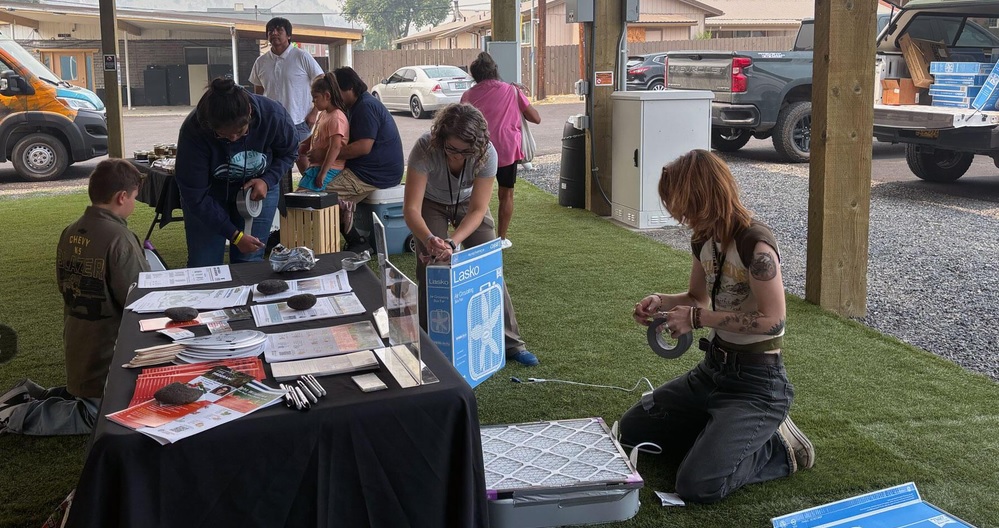
The next day, smoke muted the view of the hills surrounding Warm Springs as Cowan and Deibel set up beneath the covered pavilion at the Warm Springs Outdoor Market. Box fans, furnace filters, duct tape and illustrated instructions were spread across and beside a market table.
They distributed 55 box fans and filters, demonstrating how to secure a filter to the back of a fan with duct tape and explaining when it should be replaced.
Many residents assumed they would have to pay for the supplies, Cowan said.
“People were like, ‘How much is it?’” she said. “We said, ‘Free.’”
Some residents said they had asthma and had been confined indoors because of the smoke.
“They’ve been stuck inside, and this has been awful for them,” Cowan said. “They were very appreciative.”
The box fans, filters and related supplies were purchased with funding from the Oregon Disaster Funders Network and the OSU Extension Director’s Fund for Excellence in Extension.
People also can contribute directly to the Confederated Tribes of the Warm Springs Reservation of Oregon Wildfire Recovery Fund.
The Warm Springs delivery is one example of ongoing efforts by OSU Extension employees across Central and Eastern Oregon to respond to wildfire smoke, evacuations and agricultural losses.
Wildfires have burned more than 1 million acres across Oregon in 2026, with many of the largest incidents concentrated in Central and Eastern Oregon. The fires prompted evacuation notices, road and public-land closures and prolonged periods of unhealthy or hazardous air quality in affected communities.
OSU Extension employees have assembled or ordered hundreds of box fan filter kits, distributed thousands of N95 masks, coordinated hay and grazing assistance and worked with local, Tribal and state partners to identify needs.
Cowan emphasized that Extension’s role is not to replace firefighters, emergency managers or community organizations already leading the response.
“We can’t be part of the firefighting efforts, but the communities are hurting,” Cowan said.
Cowan is one of six regional wildland fire specialists in the OSU Extension Fire Program. The program uses outreach, education and place-based partnerships to help communities prepare for, respond to and recover from wildfire while supporting resilient landscapes.
Since the wildfires began this summer, Extension employees have been drawing on their local relationships, subject-matter expertise and connections with public agencies and organizations to help where they can.
Because Extension employees live and work in the communities they serve, they can hear about emerging needs, share information through established networks and help direct supplies where they may have the greatest effect.
They have attended community meetings, contacted shelters and retirement facilities, supported livestock owners and used county fairs, farmers markets, social media and Extension offices to reach people seeking assistance.
Box fan filters improve indoor air
As smoke pushed air quality into unhealthy, very unhealthy or hazardous ranges in Central and Eastern Oregon, OSU Extension determined an immediate need was for box fans and fan filter kits for affected communities.
A basic unit combines a box fan with a high-efficiency furnace filter to reduce fine particles in indoor air. It can provide a lower-cost way to improve air quality in a room when smoke enters a home.
In Jefferson County, the Extension office and the Central Oregon Agricultural Research and Extension Center were under a Level 2 evacuation notice as several fires burned nearby.
Despite the possibility that the facilities might need to evacuate, Olivia Davis, OSU Extension Family and Community Health outreach program coordinator, continued working with public health and other partners to assemble and distribute 100 box fan filters.
Then at an event today at the Central Oregon Communty College campus in Madras, Davis coordinated volunteers and community partners to assemble 100 more box fan filter kits. Eight high school students, two partner volunteers and David Gutierrez, OSU Extension Central Oregon Juntos and Open Campus coordinator, completed the kits in less than two hours.
The kits were distributed through Jefferson County Public Health, the Oregon Department of Human Services, the Latino Community Association and Culver School District. Each group also received KN95 masks and bilingual materials on indoor air quality, food safety, mental health and helping families cope with wildfire emergencies.
In Crook County, OSU Extension held a free event today at its Prineville office where residents could assemble and take home one of 100 box fan air-filtration units. Each unit included a box fan, a MERV 13 filter and duct tape, along with instructions on assembly, operation and maintenance.
The Crook County supplies also were purchased with funding from the Oregon Disaster Funders Network and the OSU Extension Director’s Fund for Excellence in Extension.
“Serving the needs of Crook County residents is at the heart of what we do,” said Nicole Strong, OSU Extension Central Region director. “These air filtration units are a simple but effective way to help families protect their health when smoke impacts our community.”
Crook County Extension employees also attended meetings in Prineville and Paulina to provide information and hear directly from residents.
Cowan attended a community meeting in Sisters about the Akawa Butte Fire, where she distributed a wildfire preparedness directory, guidance on managing stress during an evacuation and other information for affected residents.
Gilliam County ordered 50 kits. Shawna Holland, Family and Community Health coordinator for Crook County, coordinated the purchase of 30 units for Wheeler County, working with the Wheeler County Health Department to arrange distribution. Holland said the existing relationship between Extension and the health department helped the process move smoothly.
Four filters were provided in Hood River County for use with box fans.
Extension employees also developed air-quality plans for county fairs and other public events, including the Deschutes County Fair and the Crook County Fair.
In Jackson County, Daniela Garcia, OSU Extension Family and Community Health program coordinator, delivered 20 air filter kits to the Northwest Seasonal Workers Association. The volunteer-run nonprofit supports low-paid seasonal workers in agriculture, forestry, tourism and related industries through organizing, education and advocacy.
N95 masks reach vulnerable residents
OSU Extension offices have distributed more than 4,300 N95 masks to residents, outdoor workers and organizations serving vulnerable populations. OSU Extension also has compiled information about current air-quality conditions, reducing smoke exposure and protecting people, pets and livestock at beav.es/aqr.
In Baker County, Angela Robb, OSU Extension administrative office manager and local liaison, distributed masks over several days when Air Quality Index readings exceeded 150.
The Air Quality Index measures pollutants in the air and communicates their potential health effects. Higher values indicate greater risks, particularly for children, older adults, pregnant people and those with heart or lung conditions.
Recipients in Baker County included people with asthma or other breathing conditions, residents undergoing cancer treatment and people working outdoors. Robb also sent 100 masks to Richland.
The Baker County office later sent 1,000 masks to Wasco County to support local distribution there.
Baker County also received an air scrubber from the Extension emergency management team. The unit removes particles from indoor air, allowing the Extension office to offer a cleaner-air space for community members. One of Baker County’s air scrubbers was temporarily provided to Union County for use during its county fair.
In Crook County, Holland distributed about 200 masks at a public event where residents also learned how to assemble a box fan filter.
In Malheur County, Emerald Lewis, an OSU Extension office specialist, contacted retirement facilities and a shelter serving people without housing after air quality in Ontario reached hazardous levels. She delivered seven boxes to those organizations.
More than 1,000 masks also had been distributed directly to people who came to the Malheur County office by July 27.
The office also purchased $500 in supplies for wildfire response, including bottled water, electrolyte powder packets, protein bars, trail mix, jerky, easy-open canned food, baby wipes, insect repellent and sunscreen. The supplies were donated to Ontario Auto Ranch, which agreed to match the donation and deliver the items to a distribution center.
In Union County, Honour Bowen, OSU Extension administrative office manager and local liaison, and Darrin Walenta, an Extension agronomist, placed 12 boxes containing 200 masks each at locations throughout the county. Each site received a flyer explaining how residents could request more masks.
Walenta also provided two boxes of masks to Oregon Department of Transportation workers. Bowen shipped 200 masks to the OSU Extension office in Wasco County for use at the county fair, and masks also were made available to the public at the Union County Fair.
Hector Sanchez, OSU Extension administrative office manager in Umatilla County, provided a box of masks to the Salvation Army for distribution to employees and community members.
Agricultural and livestock support
Beyond air-quality assistance, Extension employees are helping farmers and ranchers respond to grazing losses, livestock evacuations and other disruptions caused by the fires.
At the request of the Oregon Department of Emergency Management, OSU Extension is working with state and local partners to coordinate hay, grain and monetary donations. Extension employees also are helping track needs by county, coordinate transportation and connect agricultural producers with disaster assistance.
Information about donating hay, grain or money and obtaining wildfire support is available at beav.es/wildfire-support.
In Gilliam County, Skyler Palmer, an OSU Extension general agriculture educator, distributed three surveys to assess hay and grazing needs, identify available hay donations and locate land that could be offered for grazing.
Palmer is coordinating the work with local soil and water conservation district partners after the Hay Creek Complex damaged grazing land and forage.
Scott Duggan, an OSU Extension livestock specialist, contacted the Crook County Fairgrounds to help with evacuated livestock and reached out to Warm Springs contacts about hay needs. He and Palmer also began coordinating with a Willamette Valley donor who offered hay for fire-affected livestock.
In Wasco County, Jacob Powell, an OSU Extension crops and livestock specialist and associate professor of practice, remained in contact with ranchers, farmers and first responders. Leah Lowe, the county’s Extension 4-H program coordinator, organized a 4-H cleanup at the fairgrounds so the site would be ready if needed for evacuated livestock.
In Wheeler County, Amy Derby, an OSU Extension 4-H, agricultural sciences and natural resources educator and local liaison, worked with emergency managers to identify community needs.
Katie Wollstein, an OSU Extension rangeland fire regional specialist, updated wildfire assistance information for agricultural producers and represented Extension on a field tour of the Bald Mountain Fire.
Support extends beyond the emergency
Residents should continue to follow evacuation orders and instructions from local emergency management and law enforcement officials. HazAdapt, a free app and web tool, offers guidance for preparing for, responding to and recovering from emergencies.
Extension employees also are sharing information about the AgriStress Helpline as wildfire losses and uncertainty place additional strain on agricultural and forestry communities. Farmers, ranchers, fishers, foresters and their families can call or text 833-897-2474 at any time for free, confidential support.
Deibel said people at the Warm Springs event shared the helpline information with friends, relatives and livestock owners they believed could benefit, including some who reportedly had lost entire cattle herds.
As the immediate response continues, Extension employees and their partners are beginning to consider longer-term needs, including assistance for landowners, livestock producers and communities recovering after the fires.
“It’s better to be proactive than reactive,” Cowan said. “This can give us ideas for what we can do next year.”