
(photo: Amanda Loman)
By Oregon State University Extension Office,
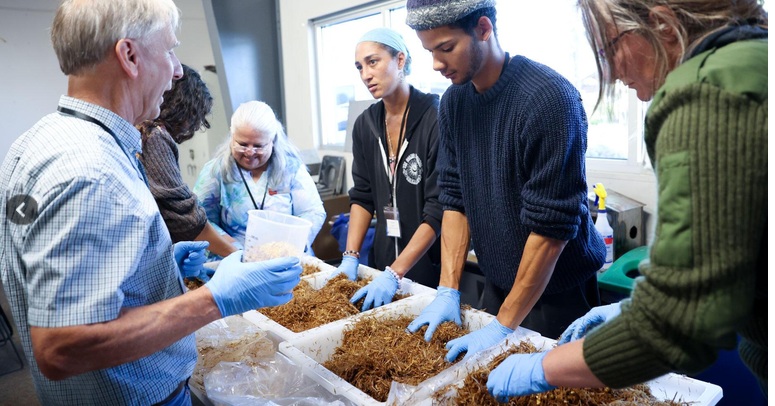
OREGON CITY, Ore. — Wearing blue gloves, Small Farm School students plunged their hands into bins of damp straw, mixed in mushroom spawn and packed the material into clear plastic bags.
The bags would go home with them, ready to colonize and eventually produce oyster mushrooms. Around the room, students worked shoulder to shoulder as Oregon State University professor Barry Pryor explained how moisture, temperature, carbon dioxide and cleanliness affect mushroom production.
The activity was one of dozens of classroom sessions and hands-on workshops offered at the 15th Small Farm School, an annual event organized by the Oregon State University Extension Service Metro Small Farms Program and held at Clackamas Community College.
About 275 people participated this year to learn about topics ranging from soil and water management to beneficial insects, greenhouse production and specialty mushrooms.
The event is designed for beginning and experienced small-scale farmers, as well as people interested in farming and food production. Heidi Noordijk, OSU Extension Metro Small Farms coordinator, said its value goes beyond individual classes.
“The opportunity to network with other farmers is highly, highly valuable,” Noordijk said.
A school for small farms
Small Farm School began in 2012 after Clackamas County provided funding for a program assistant to work with Nick Andrews, then an OSU Extension small farms specialist. County leaders were familiar with Extension’s Tree School and wanted a similar event for small-scale farmers, Noordijk said.
Noordijk helped create the event and has remained involved through all 15 offerings.
In 2020, Small Farm School moved online because of COVID-19 pandemic safety protocols. In 2021, classes were held outdoors only before the event returned to a mix of indoor and outdoor instruction in 2022.
More than 300 people attended last year, when the school offered 34 classes. Participant feedback suggested there were too many choices, Noordijk said, so organizers reduced the number this year.
Clackamas Community College’s Oregon City campus includes a farm, orchard, greenhouses and a high tunnel, allowing instructors to move between presentations and field demonstrations.
This was the 12th Small Farm School for Chris Konieczka, chair of the college’s horticulture department and lead faculty member for its organic farming program.
“It’s a fantastic event that brings together the farm education that I’m doing here with the broader community,” Konieczka said. “It offers my students the opportunity to learn new things and to understand that they’re part of a bigger community of growers.”
That combination of classroom instruction and direct experience is central to Small Farm School.
Beginning and aspiring farmers can explore unfamiliar enterprises, while more experienced producers can refine practices they already use. Farmer panels offer lessons from people who have made decisions — and mistakes — in their own operations. Exhibitors give attendees opportunities to meet organizations and businesses that serve agriculture.
That approach was evident in Greenhouse Health 101, where students first learned about plant health in a classroom, then walked to a nearby heated high tunnel to examine how temperature, humidity, airflow and sanitation affect disease risk.
Prevention starts in the greenhouse
Luisa Santamaria, professor and OSU Extension plant pathologist, encouraged students to look beyond a damaged leaf or struggling plant and consider the conditions surrounding it.
Yellowing, wilting, leaf spots and other symptoms might indicate disease, but irrigation, nutrition, temperature or other environmental stresses can cause similar symptoms. Identifying the problem means considering both what the plant looks like and the conditions in which it is growing.
Greenhouses can create favorable environments for pathogens when humidity, irrigation and sanitation are not carefully managed. High humidity and condensation can favor diseases. Poor airflow can slow drying and saturated roots can increase the risk of root rots.
Santamaria emphasized that everyday practices such as managing irrigation, improving airflow, scouting regularly and keeping growing areas clean can help students recognize problems early and reduce conditions that favor disease. During a hands-on activity, participants made decisions about sanitation practices that could help prevent plant pathogens from entering a greenhouse.
She also explained why cleaning comes before disinfection. Soil, plant debris and other organic matter can harbor pathogens and reduce the effectiveness of disinfectants.
After the classroom portion, the group followed Konieczka to the college’s heated high tunnel, where he pointed out fans, louvers and drip irrigation used to manage temperature and moisture.
Conditions varied from about 70 degrees near one end to the mid-80s farther inside. Konieczka said disease problems often appear first in the warmer south end.
Because the heated high tunnel is managed under organic standards, prevention is especially important. Plant spacing, vertical trellising, scouting and resistant varieties help reduce disease pressure. After powdery mildew affected one cucumber variety, staff replaced it with a more resistant one and saw better results.
Hedgerows offer habitat through the seasons
Another class looked to habitat along field edges.
Heather Andrews, senior faculty research assistant with OSU Extension at the OSU North Willamette Research and Extension Center, and Corin Pease, pollinator conservation specialist with the Xerces Society, co-taught the session. Andrews focused on beneficial arthropods and hedgerow research, while Pease covered site and plant selection for different ecosystems.
Andrews said beneficial arthropod populations are declining worldwide, with habitat replacement and climate change among the factors. Hedgerows can provide nectar, prey and nesting areas while supporting pollination and natural pest control. They can also reduce erosion and nutrient loss.
Andrews and collaborators are studying hedgerows near diverse cropping systems. Five were installed near different crops at the North Willamette Research and Extension Center and one at the OSU Mid-Columbia Research and Extension Center in spring 2024, with another established at the OSU Southern Oregon Research and Extension Center in 2025.
The plant mix was designed to provide blooms across the season. Among the strongest performers were goldenrod, Pacific ninebark and oceanspray, which attracted a range of beneficial insects. Perennial sunflower was a standout, providing nectar for lacewings and lady beetles before blooming and extending flowers into October.
Overall, the hedgerows provided overlapping blooms from early spring into late fall and attracted numerous beneficial arthropods.
“If you remember anything,” Andrews told the class, it is that hedgerows can provide food throughout the growing season when the right plants are selected.
From straw to mushrooms
In the specialty mushroom class, Pryor moved from production biology to a hands-on demonstration.
His students included people curious about mushrooms as well as those considering small-scale production. Pryor explained that successful production depends on controlling the growing environment and keeping careful records.
Temperature, humidity and carbon dioxide can be monitored with relatively inexpensive sensors and controllers, and simple sheds or hoop houses can work as production spaces when those conditions are managed.
Pryor also emphasized tracking results when changing variables such as temperature, substrate ingredients or the amount of spawn.
“If you’re going to be a grower and you want to improve, you have to record your data,” he said. Otherwise, he added, “we’re going to be guessing without knowing.”
Students learned about mushroom “flushes,” the bursts of mushrooms produced by colonized substrate. The first flush can account for much of a bag’s total yield, while later flushes produce progressively less.
Then the gloves went on.
Students worked around bins filled with loose straw or denser straw-pellet substrate. They added mushroom spawn, mixed it thoroughly and packed the inoculated material into bags. Each student could take a bag home and continue the process.
Learning from each other
For Noordijk, one of Small Farm School’s strengths is the chance for attendees to learn from one another as well as from instructors.
Konieczka, who worked as a small farms Extension agent at the University of Illinois before joining Clackamas Community College, said that exchange is one reason he continues to participate.
“I see the benefit that comes from getting that research-based information into the hands of the public,” he said.

Disclaimer: Articles featured on Oregon Report are the creation, responsibility and opinion of the authoring individual or organization which is featured at the top of every article.